|
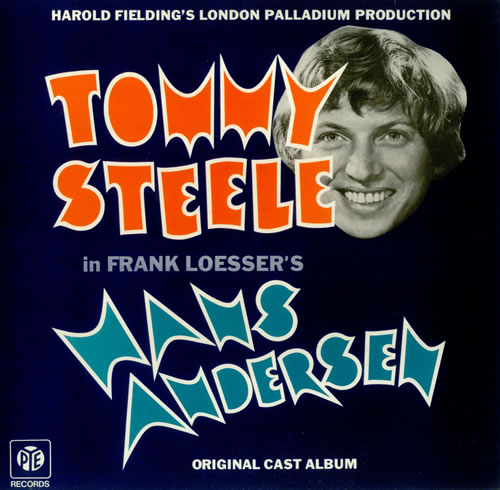
Hans Christian Andersen
Music & Lyrics by Frank Loesser
Movie 1952
Synopsis
ACT ONE
Act One: The scene is an 1830s village square in Odense, Denmark.
There we see a schoolhouse, a town hall, and the cobbler shop of Hans
Christian Andersen. Nearby stands a two-wheeled cart, which is large
enough to hold all his equipment, and a smaller cart that can be
pushed by a young boy. In “I’m Hans Christian Andersen” he
introduces himself as a world-class storyteller, who will, “mend
your shoes and fix your boots when I have a moment free.” The
towns’ children gather round him. At the end of the song, Hans leads
them around the stage a la the Pied Piper, ending up in front of his
shop for story time.
The schoolmaster rings the bell to announce the beginning of
school—the children gather closer to Hans. He rings it again and the
children continue to ignore him. In a rage, this dry, angry,
apoplectic little man returns to the schoolhouse, puts the bell on his
desk, picks up his hat and storms into Town Hall.
The other children tease Anna, the smallest child in the group, until
she cries. For Anna, Hans chooses the tale of “Thumbelina,” a
little girl “no bigger than my thumb.” He sings “Oh, Thumbelina,
What’s the difference if you’re very small? When your heart is
full of love, you’re nine feet tall.” Hans’ apprentice is Peter,
a serious boy of 12 or 13, who enters frantically at the end of the
song, reporting that the schoolmaster has complained about Hans to the
Burgomaster, and the town council is on its way over. The schoolmaster
issues an ultimatum: “either Hans leaves the town, or I do.” Peter
pleads that the children learn from Hans’ stories,” but the
Burgomaster reluctantly goes along with the schoolmaster and announces
a meeting this afternoon at which he will decide who must leave the
town. The Burgomaster sends the children off with the schoolmaster,
and Hans and Peter are left alone.
Hans begins work on a shoe, and Peter, whom Hans rescued from an
orphanage, is worried sick about losing Hans. Hans criticizes
Peter’s handiwork and wonders if Peter really wants to be a cobbler.
In the background, the children sing a repetitive, rote recital of
their addition tables and Hans picks a marigold and point out an
inchworm worrying away: he sings “Inchworm, Inchworm, measuring the
marigolds, seems to me you’d stop and see how beautiful you are.”
Hans crosses to the schoolhouse as Peter continues singing. The
schoolmaster shuts the door in his face. Hans determines to leave the
town. Peter is elated to find that Hans will take him along. They load
the large cart and post a sign in the shop window that he’s gone to
Copenhagen. They reprise “Hans Christian Andersen” as the scene
becomes the wonderful seaside town of Copenhagen.
On the road they encounter Truls, a sea captain, who gives them a hand
to speed their journey. Upon arrival in the market square, they
encounter vendors singing their calls for fish, milk, sausages,
newspapers, matches, chimney sweeping and vegetables. Truls introduces
Madam Doro, Prima Ballerina of the Royal Ballet, accompanied by her
handmaid Celine. Hans is smitten by the diva’s beauty; Peter
snickers. Hans wants to follow her; Truls explains that she can always
be found at the Opera House where she dances.
Peter is eager to get to work. They set up shop in the Town Square
under the kind and watchful eye of the statue of the King. Truls
exits, wishing them luck. Hans sings “Wonderful, Wonderful
Copenhagen” as the town’s children gather round to listen and be
drawn into Hans’ tale of his mighty ship “Dauntless.” At the end
of the song, the children “disembark”. The school bell rings, and
Peter reminds Hans that the children must go. Hans leads the children
over the bridge to school.
Niels, the handsome lead dancer and director of the Royal Ballet,
storms on followed by Otto, the impresario. Madam Doro wants new shoes
NOW to accomplish a particular effect in her dance. She needs a shoe
that is silent and soft so that she can appear to be dancing on air.
Otto is sent off to find a cobbler. Peter leads him to Hans, who is
taken to the Madam: “Our first job in Copenhagen, and it’s for
her!”
At the Opera House, several dancers are working out at the barre. Rik,
the stage manager, calls the company; Doro takes the stage. The first
variation is a solo for Madam Doro, followed by the second movement in
which she is accompanied by the ensemble. The third variation is to be
a pas de deux between her and Niels. He bows; she curtseys to the
floor. And there she stays. Otto reminds Niels that Madam has refused
to go any further without her special shoes. Hans is brought forth.
Madam Doro explains the effect she wishes to create; Hans says he can
make the shoes. Doro impulsively kisses him on the cheek. Hans is
stunned and dazedly goes off to find Peter and begin work on Madam’s
new shoes.
Doro calls for her lunch, which Celine brings out. Niels and Otto
discuss Doro. We discover that Niels and Doro are married and drive
each other nuts! She tortures him; he criticizes her. They sing “No
Two People” over lunch: “No two people have ever been so in love
as my lovey dove and I.” Alas, Niels verbally attacks her, alleging
limitations in her dance abilities and an insane preoccupation with
the silent shoes she’s commissioned from Hans. She slaps him, then
slaps him again. He turns her over his knee and spanks her. She
struggles, bursts free, and runs weeping from the stage.
Hans, having witnessed this scene, is appalled. Hans, transfixed,
fantasizes. His recorded voice is heard: “How could you do it? How
could you marry him?” Doro appears, dancing in and out of distinct
pools of light on the stage, saying, “No one can help me! No
one…he makes me dance for him…I can only dance…dance…” She
continues to dance as Hans sings, “Anywhere I Wander.”
Back at the Market Place, Hans crosses to his cart, sits on a stool
and begins writing. Peter enters to distract Hans; Hans dismisses
Peter, but Peter’s rosy spirits won’t be dampened. Mrs. Olsen
enters grandly, authoritatively, to do her shopping. When she leaves,
vendors Gustave and Henrich close their carts and exit. Hans finishes
writing, and shows the pages to Peter: ‘The Little Mermaid – A
Story for Madam Doro by Hans Christian Andersen.” Peter is shocked!
Madam is, after all, married. Hans resolves to help her somehow;
through his story he hopes to show Doro she has a friend in him.
Madam Doro enters to thank Hans for the shoes. They are perfect and
silent! Niels follows, saying, “Now, if you could only do something
to silence her!” Hans is saddened. Peter embarrasses Hans deeply by
giving the pages to Doro. Doro is visibly moved, and tells Hans
she’ll read it on tour. Hans is shocked to hear she’s leaving.
Niels notes Hans’ reaction to his wife and concludes that it’s a
good thing they’re leaving town for awhile. Act One Ends.
ACT TWO
Act Two begins at the marketplace, where Hans now has added a rod to
his cart from which hang eleven pairs of new ballet shoes. Everyone is
onstage: Peter the friendly policeman, all the children, townspeople
and vendors. They reprise “Wonderful, Wonderful Copenhagen.” Our
attention is directed at the end of the chorus to a young boy, Lars,
and his mother, Mrs. Holm. She’s walking him to school today because
he played hooky yesterday. He begs her to let him go alone; she
reluctantly agrees when he promises to go to school. As he passes, the
girls giggle and the boys shun him.
Music rises again; the singers promenade and the dancers waltz. Peter
waltzes with the Little Match Girl. Hans waltzes with Anna. A school
bell is heard as the applause fades. Girls exit by twos; the boys
surround Lars and grab his hat. We see that he is bald as an egg. The
policeman intervenes and the boys disperse. Hans takes the cap from
the cop and crosses to Lars, who is visibly upset by the harassment.
Hans comforts Lars, whose doctor had shaved his head when the child
was ill. Hans sings Lars the story of “The Ugly Duckling,” who
becomes a beautiful swan. Lars, whistling and smiling, exits,
presumably to school.
Mrs. Hofgaard enters and Peter drives a hard bargain for a three
kroner job. Hans takes the twelfth pair of ballet shoes from behind
the cart and hangs it from the rod. It has been twelve weeks since the
Ballet Company went on tour, and Peter, who has become quite a
businessman, is concerned that they won’t be paid for the ballet
shoes. Hans, oblivious to Peter’s frustration, falls into a reverie,
his second fantasy, in which he and Doro sing, “No Two People,”
and all the shoes fit her perfectly. The fantasy ends and Peter and
Hans are as they were.
Editor Holm is the father of Lars, the Ugly Ducklings. He comes to pay
Hans a visit and thank him for making his son feel so much better. He
asks if it is true that the schoolchildren visit Hans before and after
school for the cobbler’s special stories. Hans, who has been evicted
from one town for distracting the children there, admits that, yes,
the children come to him. Far from sending Hans packing, Editor Holm
offers to publish the story of “The Ugly Duckling,” if Hans can
complete its writing in two hours. Hans sets right to work. “Tick
Tock” is an open-ended, time passage number in which everyone who
encounters Peter is shushed apace: vendors mouth their calls and the
townspeople tiptoe around as Hans writes in quiet. Upon the story’s
completion, Hans hands the story to Lars for his father and everyone
utters a collective sigh of relief.
Madam Doro returns from her tour with the ever-pompous Niels. He is
still jealous of Hans’ attention, but they invite him to narrate the
ballet they have created of Hans’ “The Little Mermaid.” He
consults with Peter, his “business manager.” Peter holds out for
more money and requires payment for the twelve pair of shoes. Doro
asks Hans to see the shoes. Peter is sent to get hot chocolate for
Doro and Niels goes off to the theatre with instructions for the
others to hurry along. Doro and Hans are left alone in the street. He
confesses that his story was for her, that he knows haw unhappy she
must be, having witnessed their terrible fight those weeks ago.
“No,” she says, “I’m not miserable. That’s just the way we
are sometimes. I love my husband, Hans.” Hans feels like a fool.
Doro comforts him and wonders if he knows the strength of his gift for
speaking to the heart. “Even where there seems to be no heart,”
she says, “you waken one.” He has given her a treasure in “The
Little Mermaid,” and she promises to remember him privately and
thank him publicly each time she performs it. She goes to the theatre,
instructing Hans to hurry along. Hans reprises “Anywhere I
Wander.”
Peter arrives with hot chocolate, but Madam is gone. Hans tells Peter
to drink it himself. And what about the shoes? Did she pay for them?
Peter is a little annoyed. Hans explains that she more than paid him
for she shoes; that there are some things Peter doesn’t yet
understand. Peter, frustrated, sends Hans off to the theatre.
The next scene is the actual “Little Mermaid” ballet, based on
Andersen’s tale in which a young mermaid girl dreams of her future
freedom to explore the surface of the sea. She saves the life of a
wounded sailor and falls in love with him, even as rescuers carry him
away. She watches night and day for his return, and journeys to visit
the sea witch who has powers to turn her into a human so she might
find her love.
At the end of the ballet, the curtain closes, the company bows, and
congratulations are extended to Hans, Niels and Doro. Stage Manager
Rik goes home and Doro kisses Hans in thanks. Niels thanks Hans as
well, and they invite him to supper. Hans declines: “My head is
bursting with ideas, so many stories to tell and who knows if
there’s time to tell them.” He vows not to forget these lovely
dancers who, in Hans’ words, “opened up my life for me.”
In the next scene we find Hans seated again by his cart, but he has
returned to Odense, where there is a banner stretched across the
schoolhouse to "Welcome Home Hans!” The village turns out and a
beaming schoolmaster stands next to Hans. The children are gathered
around him with adults around the periphery. He’s just finishing the
story of “The Little Match Girl,” when the children beg for one
more story. Hans demurs: “No, no…I’ve learned my lesson. It’s
time you were in school. Isn’t that right, Schoolmaster?” The
Schoolmaster replies that the children have missed him, as have the
townspeople and – Heaven forbid – so has he. “Let’s have one
more story.” He tells the story of “The King’s New Clothes,”
including children in the pantomime of the action and the song. The
Villagers applaud.
The Burgomaster announces that emissaries from King Frederick VI have
arrived to see Hans. The emissaries turn out to be Doro and Niels, who
acknowledge Hans as the undisputed “King of Stories” and bestow a
medal from the grateful monarch and a Royal pension voted by a
grateful people. Doro hangs the order around Hans’ neck and kisses
him on both cheeks. He looks after her with longing.
The chorus sings “Anywhere I Wander, Anywhere I Roam.” Hans looks
front and smiles as the orchestra plays, “I’m Hans Christian
Andersen, That’s Me.” Curtain.
Song List
- Overture
- Thumbelina
- This Town
- Dare To Take A Chance
- Truly Loved
- For Hans Tonight
- Dare To Take A Chance (Reprise)
- Jenny Kissed Me
- Inchworm
- Ecclesiasticus
- Anywhere
I Wander
- Wonderful Copenhagen
- I'm Hans Christian Andersen
- Happy Days
- Have I Stayed Away Too Long?
- Ugly Duckling, The
- No Two People
- King's New Clothes, The
- Anywhere I Wander (Reprise)
Info
Related
Licensing Agent
Music Theatre International
421 W 54th St New York, NY 10019
212.541.4684
Fax 212.397.4684
|
|